2nd Solo Show - 藍 Blu
Exhibition Period: Sept 26th - Nov 15th, 2025
Location: Galeria Madragoa. Lisbon, Portugal (Rua dos Navegantes 53A 1200-730, Lisboa - PORTUGAL )
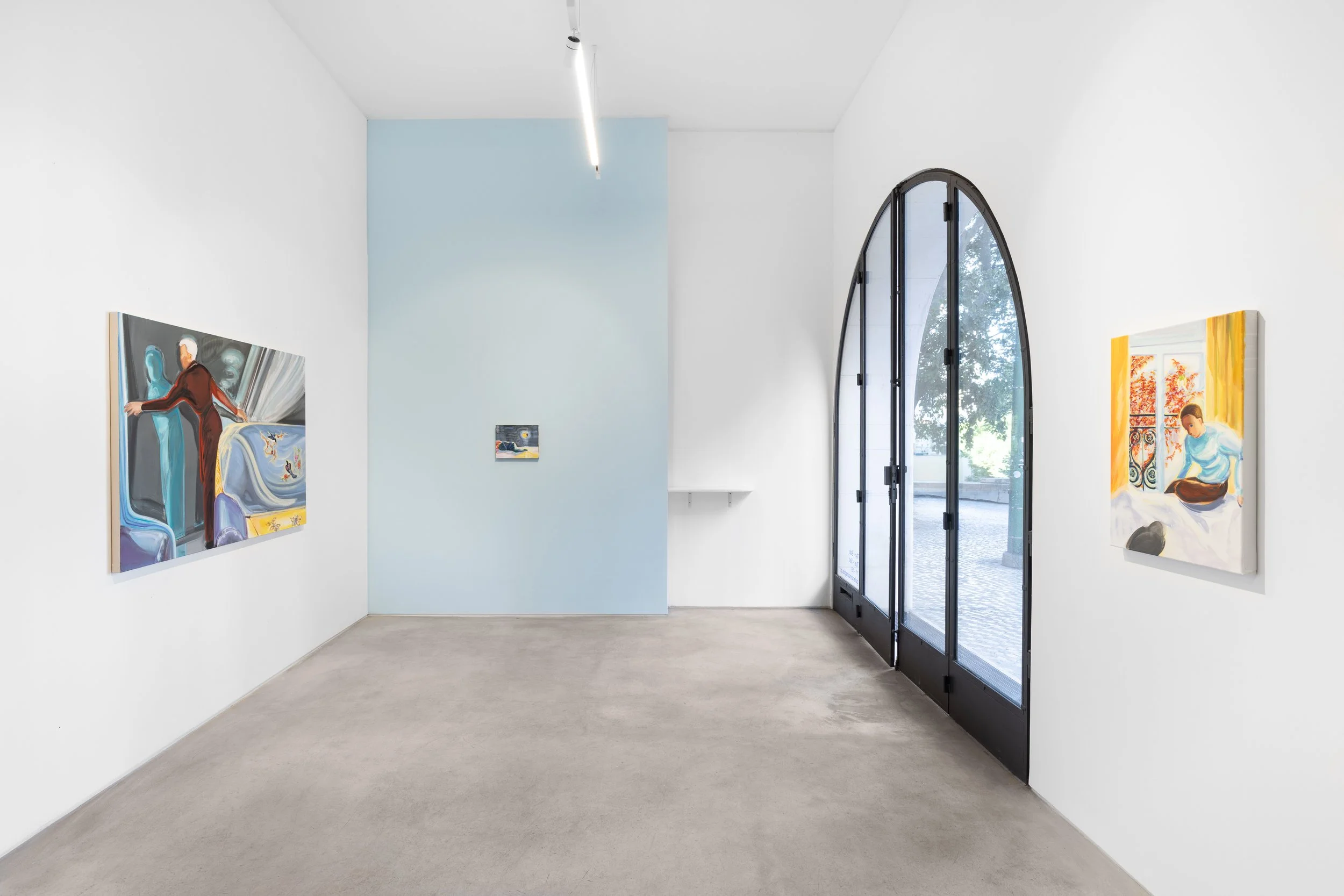
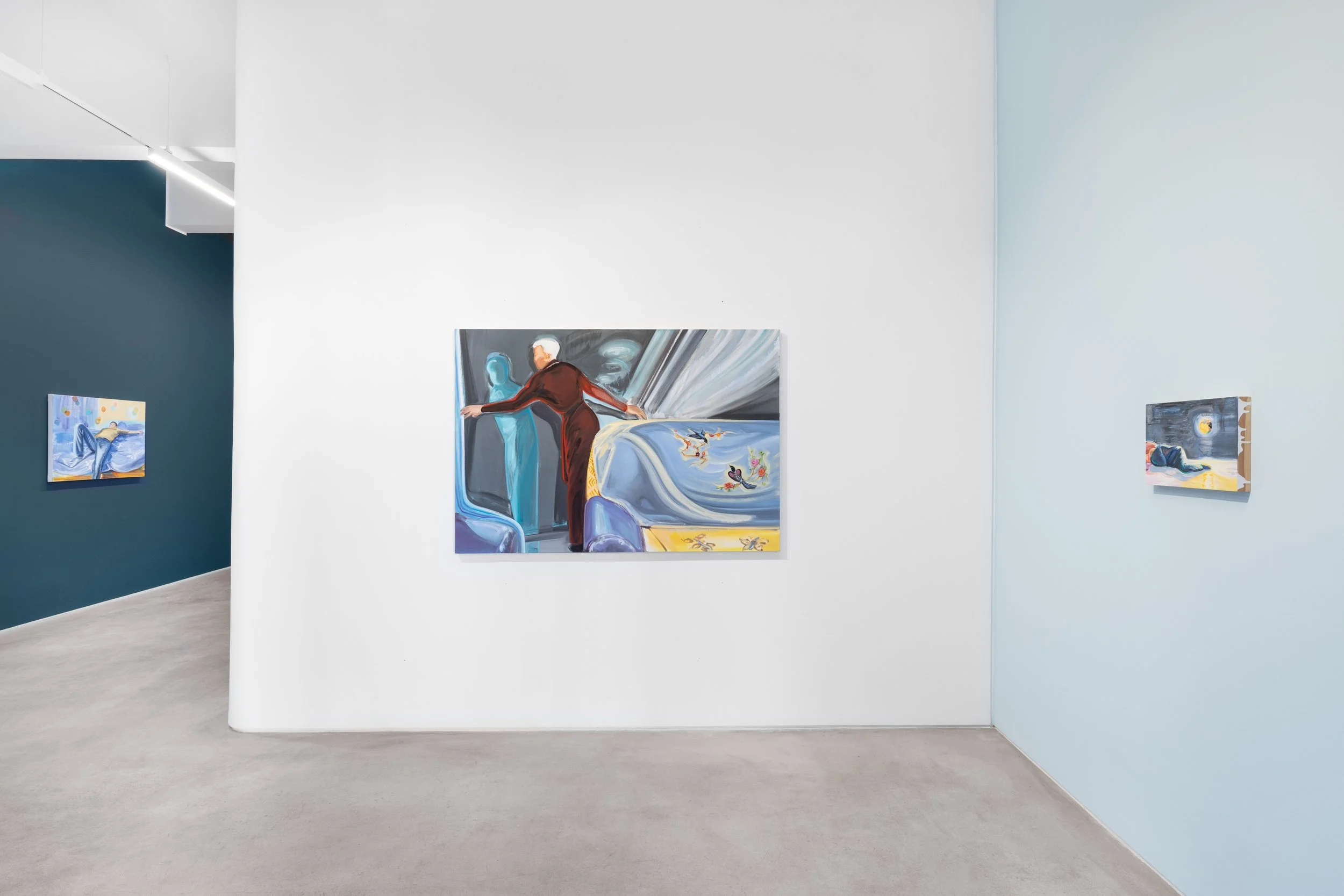
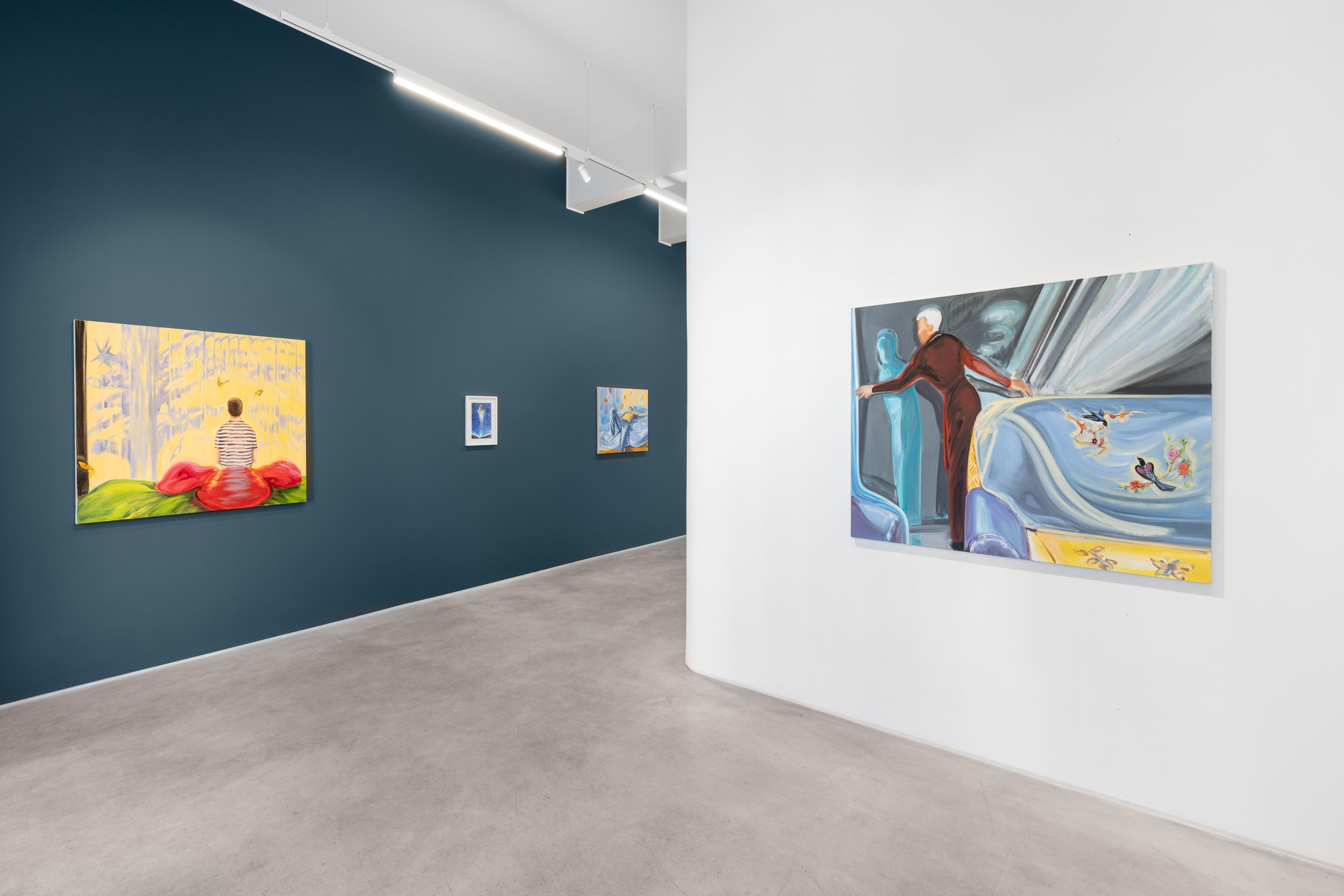
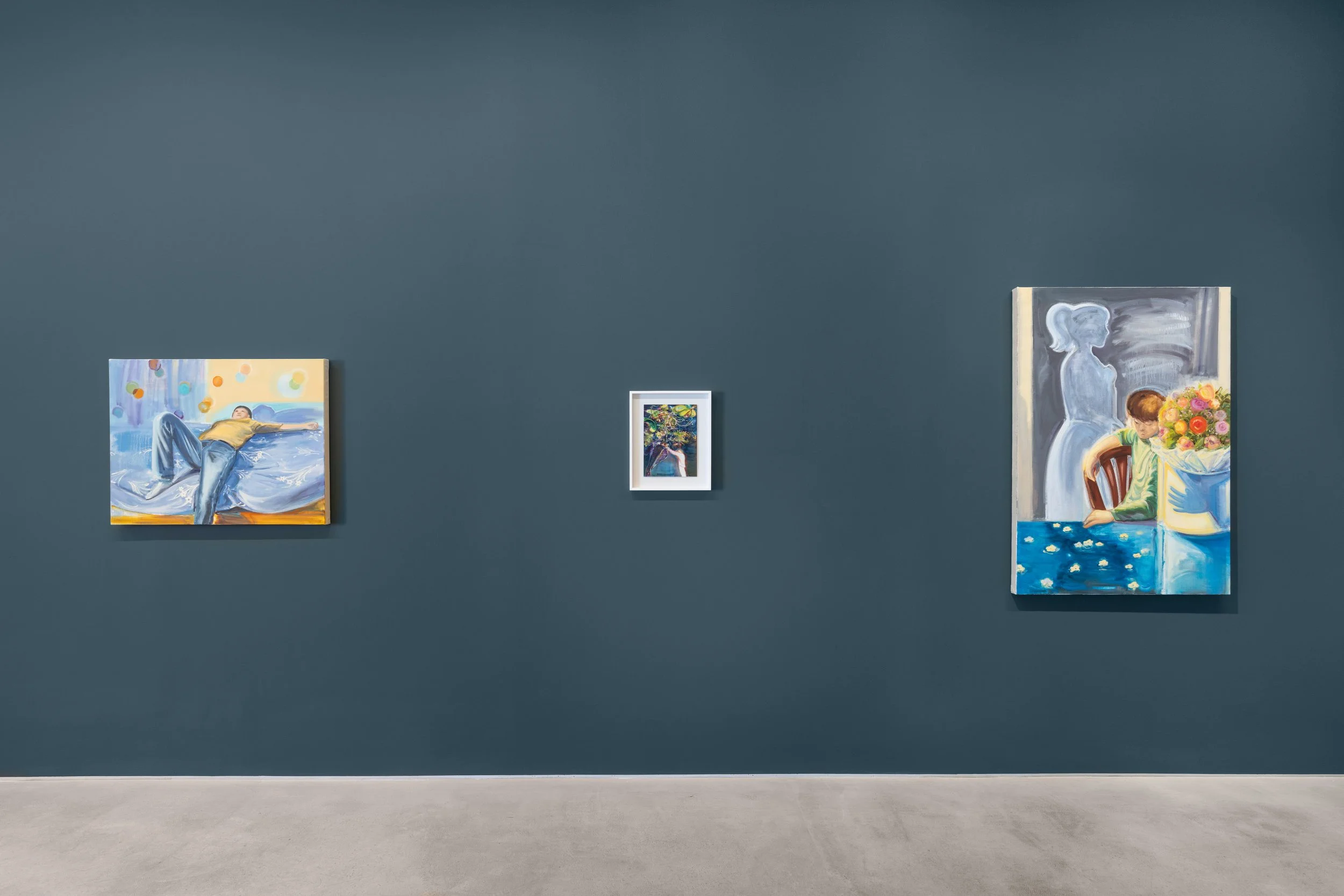
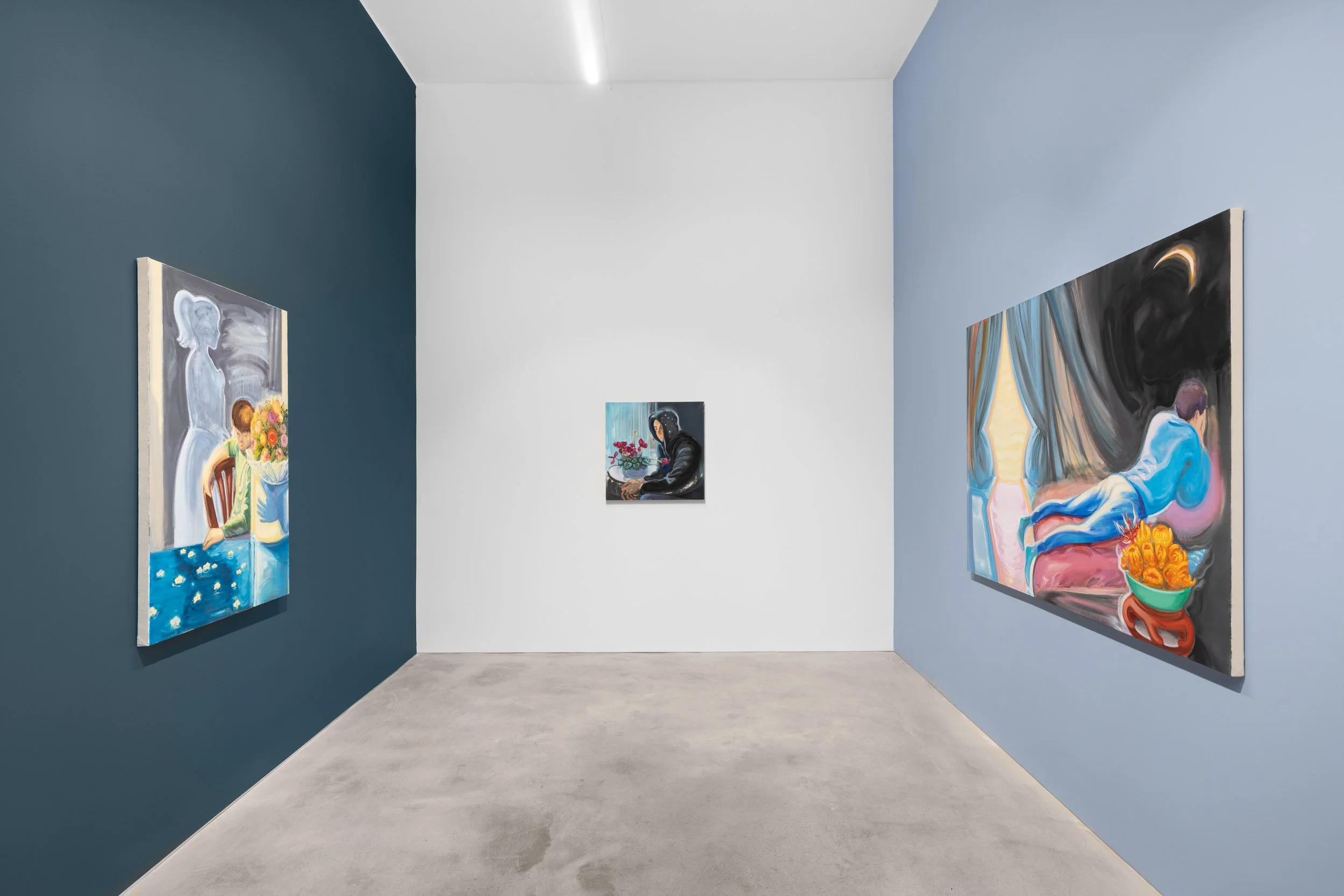
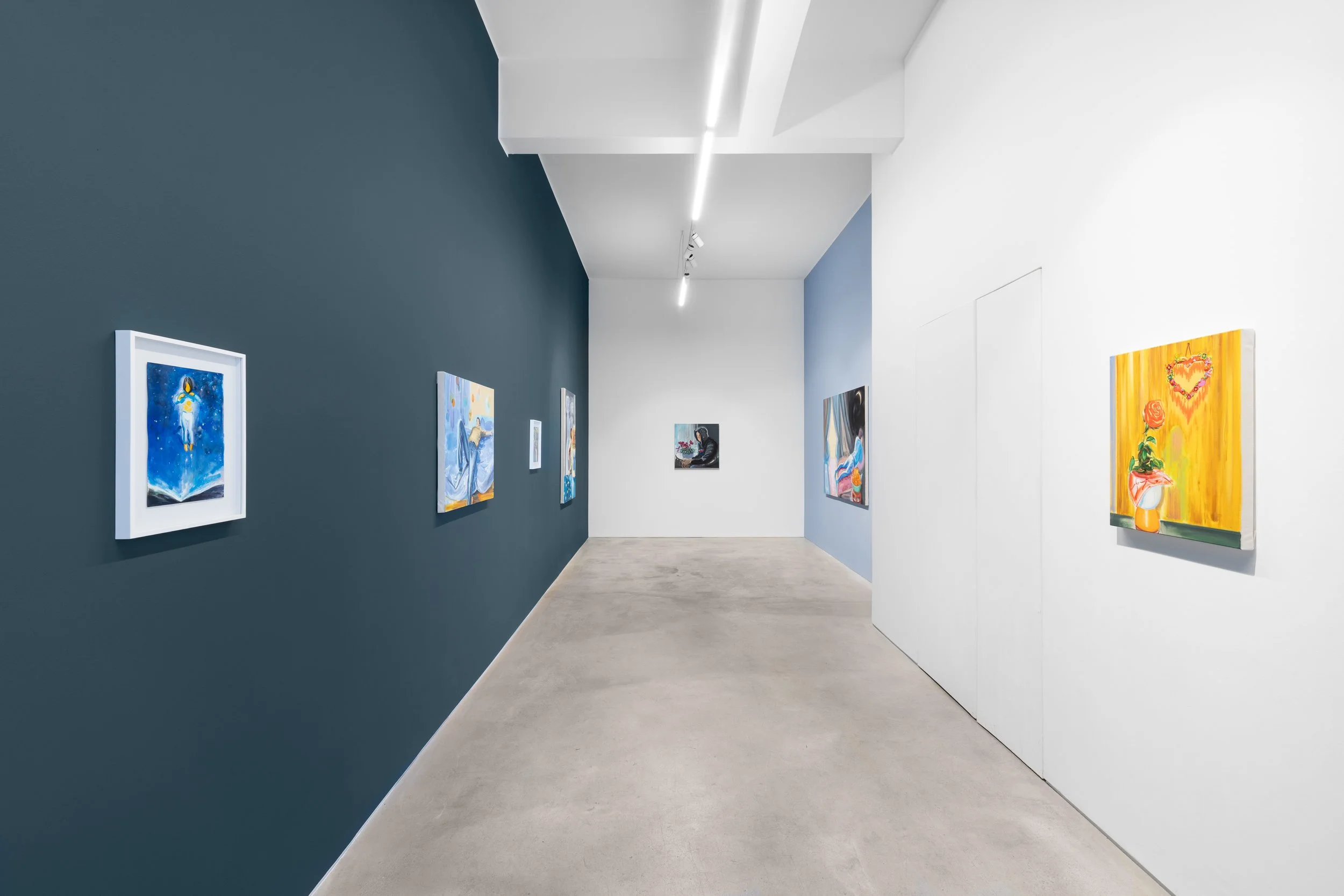
Photo credit: Bruno Lopes
Press Release:
In this new body of work by Qianyu Li, the domestic settings in which the scenes depicted unfold seem to open up onto other dimensions. Windows—long a metaphor in painting—open onto the outside world, but that's not all: here, the exterior and interior interpenetrate and merge. Sometimes it seems as if the back wall itself is disappearing, with curtains like real stage wings opening onto a night sky, a mysterious backdrop onto which shadows with the sharp outlines of statues are projected, or a crescent moon appears in the darkest corner of the room.
Speaking of stage structure, it seems as if viewers are facing the fourth wall, an expression that, in theater terminology, indicates an “imaginary wall” in front of the stage, through which the spectator observes the action taking place in the work being performed. Rather than acting, the protagonists of the paintings seem to be curled up in on themselves, engaged in an inner monologue, with the observer intruding on their domestic intimacy.
Almost all young, the figures depicted in the paintings are shown in three-quarter view, from behind, in pensive poses, lying down or asleep. They are almost never at the center of the composition, leaving space for the dreamlike, metaphysical world that takes shape in their silent dialogue with their surroundings, and in particular with nature. Flowers, birds, butterflies, leaves and trees, stars, a light and floating world revolves around these solitary and immobile figures, echoing on tapestries and draperies, transforming into luminous patterns.
If the subjects, as Qianyu Li explains, derive from the artist's personal experience—they are the people, objects, and environment that surround her—the creative process operates like a montage in which fragments from different places, spaces, and sources are assembled together to give life to a complex reality.
The montage is also emphasized by the alternation of meticulous, detail-oriented painting with larger areas where the color is more diluted and the gesture more informal and synthetic. In the canvases, the familiar and the unfamiliar coexist, creating a mysterious tension.
The series of works also expresses the artist's personal experience of Lisbon while she was living there, a city of chromatic and atmospheric contrasts: “in summer and on sunny days, it is filled with color and light, but during the rainy season with its strong winds, it can feel grey and even slightly threatening. These contrasting impressions are reflected in my use of contrasting palettes throughout the paintings.”
The color blue, in its various shades, is the common thread running through the paintings, giving the exhibition its title, which expands to color the walls of the gallery in different hues. Blue—with all its overflowing symbolism—does not only denote color.
In Bluets (2009), a hybrid text that is part poetic essay, part memoir, and part philosophical meditation, Maggie Nelson analyzes the color and its various facets in a decidedly unconventional way, gathering an unexpected repository of ideas and experiences related to blue. Interweaving personal reflections, memories, artistic and philosophical references, blue becomes a prism through which to talk about desire, loss, pain, love, and transcendence, in a meditation that starts out intimate and becomes universal.
In this series of paintings by Qianyu Li, too, different moods revolve around the color blue.
In Bluets, the author uses blue not only as a color, but as a metaphor for a perceptual and emotional condition. In one passage, Nelson refers to the ancient theories of perception of Epicurus, Plato, and Aristotle, questioning the presumed linearity of seeing: do we project our gaze onto objects, or do they reach us with their presence?
“Long before either wave or particle, some (Pythagoras, Euclid, Hipparchus) thought that our eyes emitted some kind of substance that illuminated, or ‘felt,’ what we saw. (Aristotle pointed out that this hypothesis runs into trouble at night, as objects become invisible despite the eyes’ purported power.) Others, like Epicurus, proposed the inverse—that objects themselves project a kind of ray that reaches out toward the eye, as if they were looking at us (and surely some of them are). Plato split the difference, and postulated that a ‘visual fire’ burns between our eyes and that which they behold. That still seems fair enough”.
And it seems fair enough even when looking at Qianyu Li’s work, in which color emanates from the canvas and moves toward the viewer, an inner sense of light—as if the canvas itself were glowing from within.
Text by: Sara De Chiara
Source From: https://www.galeriamadragoa.pt/exhibitions/68cbd7c4d009149206a29026